Home › Home lab › The four kits

The four Home lab kits

A kit is a starting point: a small 10-inch rack, neat, portable and wired, with each device on its own shelf. Pick the one closest to your situation; we adjust it with you during the Diagnostic.

Free first meeting Home lab Diagnostic ($95 CAD)

Hardware: chosen with you, bought in your name (by you or, on written request, by us) and paid for by you; it belongs to you. Each kit's hardware range is an estimate, not a DRAK Infinity price. The three ways to buy the hardware are described on the Home lab page.

The four kits

The kit images are computer-generated illustrations that give an idea of each kit: they show neither a delivered installation nor a real client, and the hardware delivered may differ. The diagrams are labelled in French. The names of third-party software and services mentioned on this page and in the diagrams belong to their owners; they are neither partners nor a recommendation.

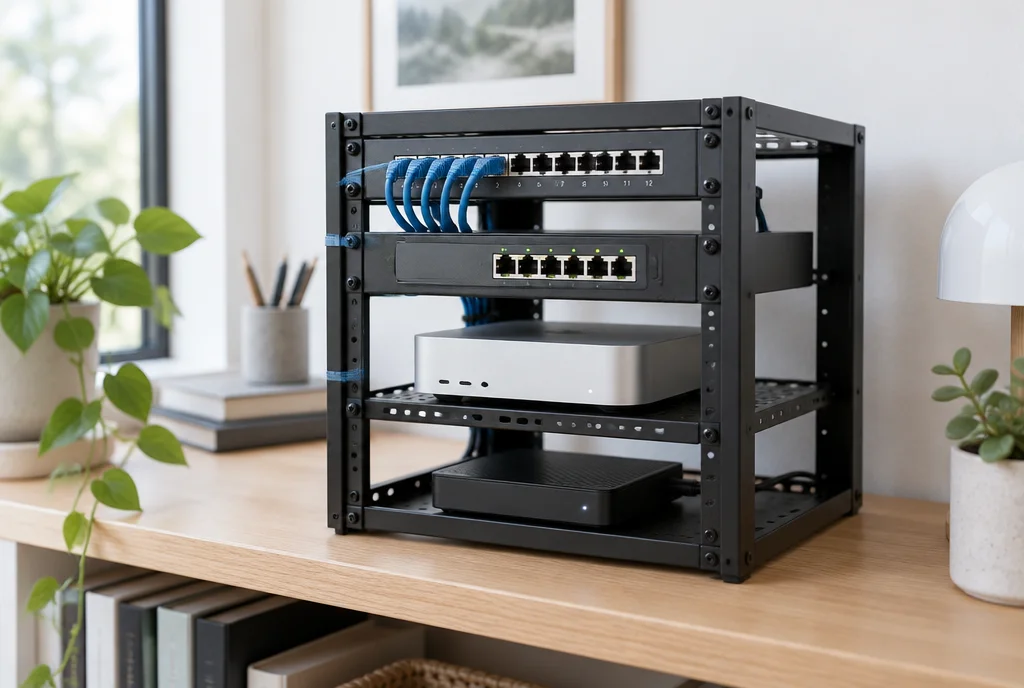
Illustration of a small four-level black rack on a wooden shelf by a window: a patch panel with blue cables at the top, a network switch, a silver mini PC on its tray and a black backup drive at the bottom.
Computer-generated illustration: the Solo kit, a small 4-unit rack.
Kit 1

Solo

Small 4-unit rack, wired; Wi-Fi optional

Who it is for
Freelancer, self-employed person, tech-savvy individual.
Contents
A patch panel, a network switch, a mini PC server and a backup drive; a small front-panel screen as an option.
Promise
Your files at home, a password vault, access from anywhere, tracker blocking and an encrypted off-site backup available.

Work: Essentiel package, 10 to 16 h, $75/h.

Hardware: $900 to $1,800, bought in your name, and it belongs to you.

Amounts before taxes: no tax charged (small supplier). Estimates are in hours: we bill the actual time spent.

See the network diagram
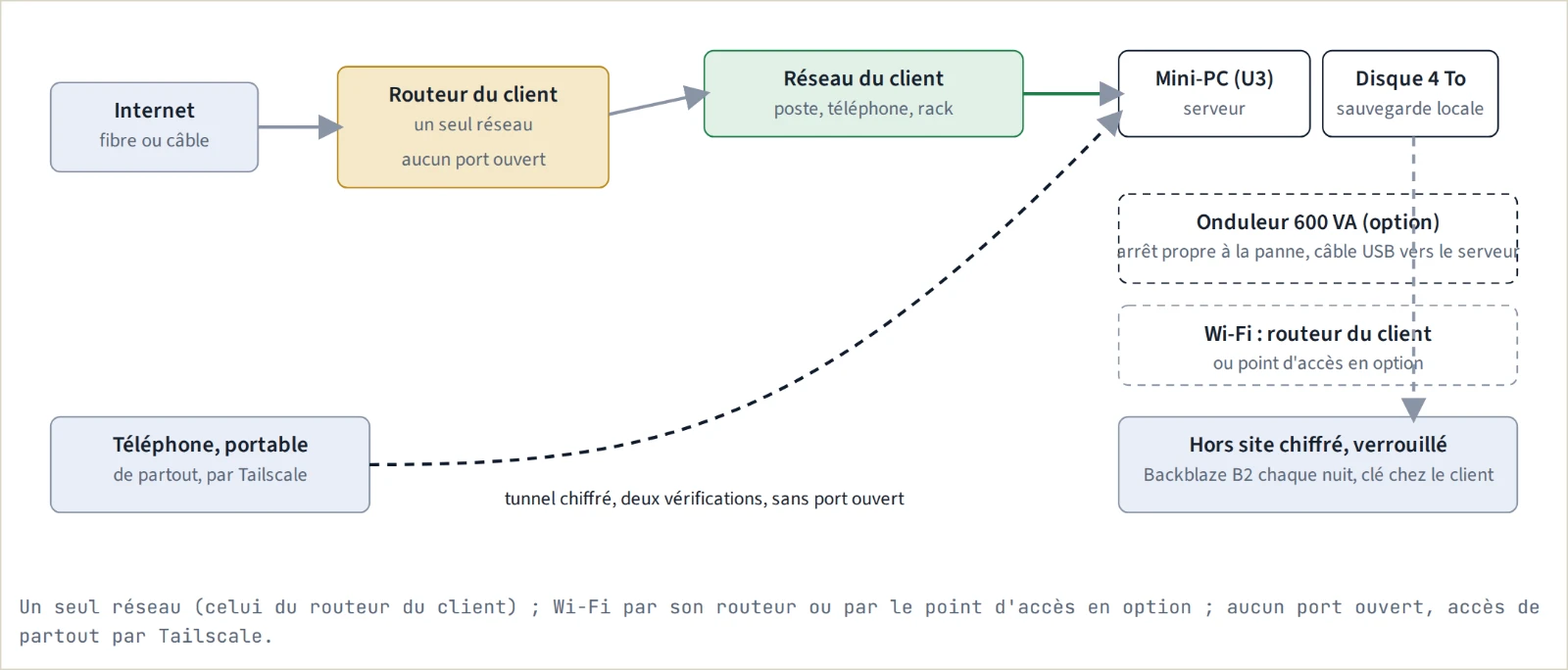
Network diagram of the Solo kit, labelled in French. Internet (fibre or cable) reaches the client's own router, which keeps a single network and no open port; that network links the workstation, the phone and the rack. In the rack, the mini PC server and a 4 TB drive for the local backup. Dashed boxes: an optional 600 VA battery backup with a clean shutdown on power failure through a USB cable to the server, and Wi-Fi, provided by the client's router or by an optional access point. An encrypted, locked off-site backup is sent every night, and the key stays with the client. The phone and laptop reach the server from anywhere through an encrypted tunnel, with two verifications and no open port.
Network diagram of the Solo kit: a single network, no open port, access from anywhere through an encrypted tunnel. The labels are in French.
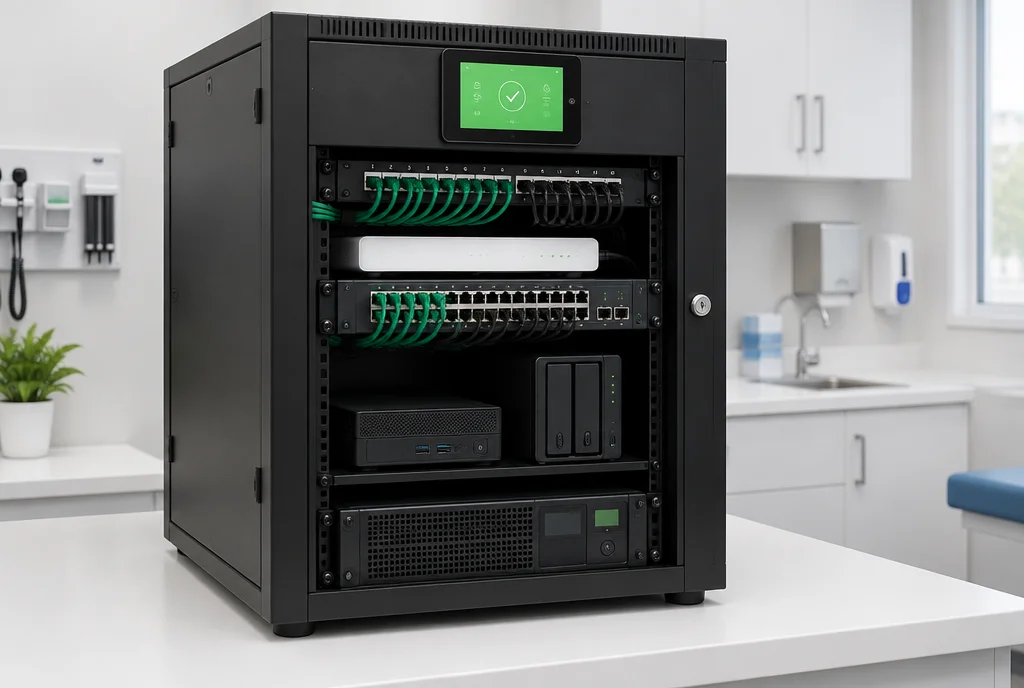
Illustration of a closed black rack cabinet on a clinic counter, with a small green screen showing a check mark on its front. Inside: a patch panel and a switch with green cables, a white router, a mini PC, a two-bay storage server and a battery backup at the bottom.
Computer-generated illustration: the Practice kit, a closed 8-unit rack.
Kit 2

Practice (clinic or office)

Closed 8-unit rack, wired, Wi-Fi included

Who it is for
Clinic, professional practice or office of 3 to 15 people.
Contents
A router, a managed switch, a mini PC server, a mirrored storage server (NAS), a battery backup, a front-panel screen and a Wi-Fi access point.
Promise
Three separate networks (team, guests, devices), role-based accounts and a three-copy backup offered to every client, one of them offline.

Work: Autonome package, 20 to 30 h, $75/h.

Hardware: $1,800 to $4,000, bought in your name, and it belongs to you.

Amounts before taxes: no tax charged (small supplier). Estimates are in hours: we bill the actual time spent.

See the network diagram
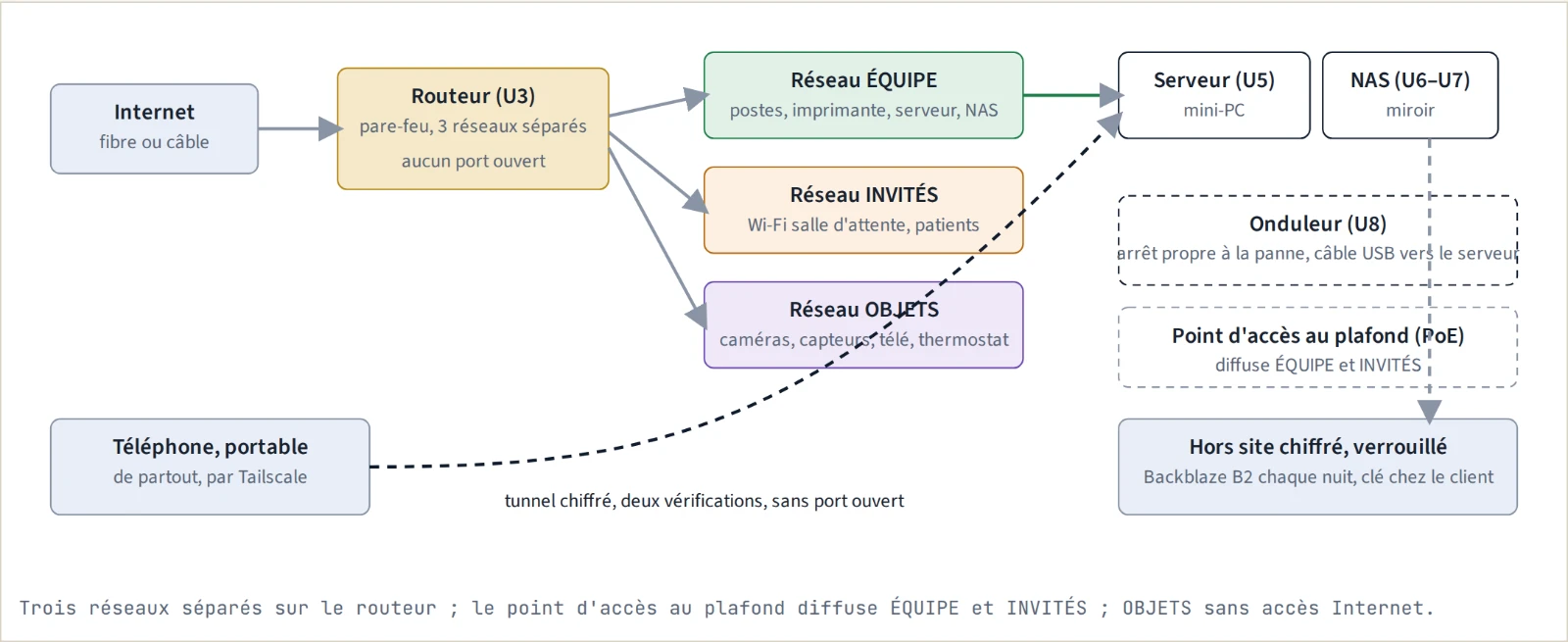
Network diagram of the Practice kit, labelled in French. Internet (fibre or cable) reaches a router (shelf 3) that acts as a firewall, separates three networks and opens no port. TEAM network: workstations, printer, server and storage server; it links the server (mini PC, shelf 5) and the mirrored storage server (shelves 6 and 7). GUESTS network: the waiting-room Wi-Fi. DEVICES network: cameras, sensors, television and thermostat. Dashed boxes: a battery backup (shelf 8) with a clean shutdown on power failure through a USB cable to the server, and a ceiling access point, powered through its cable, that broadcasts TEAM and GUESTS. An encrypted, locked off-site backup is sent every night. The phone and laptop reach the server from anywhere through an encrypted tunnel, with two verifications and no open port.
Network diagram of the Practice kit: three separate networks on the router; the devices network has no Internet access. The labels are in French.
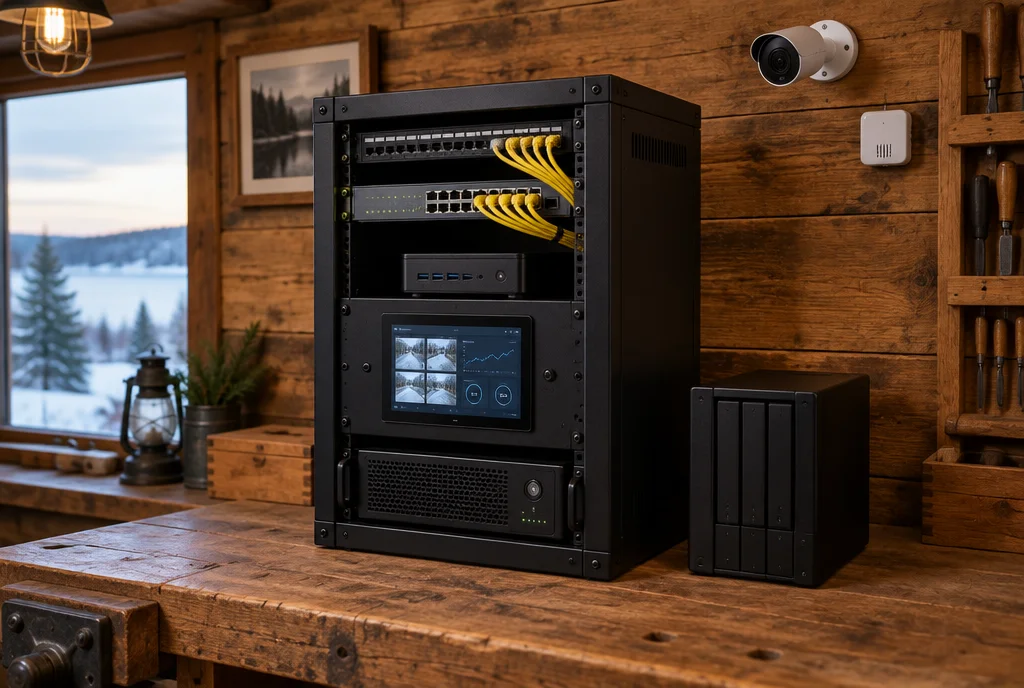
Illustration of a twelve-level black rack on a wooden workbench in a winter workshop: a patch panel and a switch with yellow cables, a mini PC, a front touchscreen showing camera images and charts, a server at the bottom. On the right, a black four-bay disk tower; on the wall, a camera and a white sensor.
Computer-generated illustration: the Workshop or Farm kit, a 12-unit rack and a disk tower.
Kit 3

Workshop or Farm

12-unit rack and a disk tower, wired, Wi-Fi included

Who it is for
Craftsperson, workshop, farm or shop with sensors and cameras.
Contents
Camera power through the network cable (PoE), local cameras, sensors, a front-panel screen, a disk tower and, when needed, a second small rack for another building.
Promise
Camera images that stay with you, alerts set up with you and the option of carrying on working when the Internet goes down.

Work: Small business package, quoted, from 35 h, $85/h.

Hardware: chosen with you, bought in your name, and it belongs to you. Depends on the site; estimated during the Diagnostic.

Amounts before taxes: no tax charged (small supplier). Estimates are in hours: we bill the actual time spent.

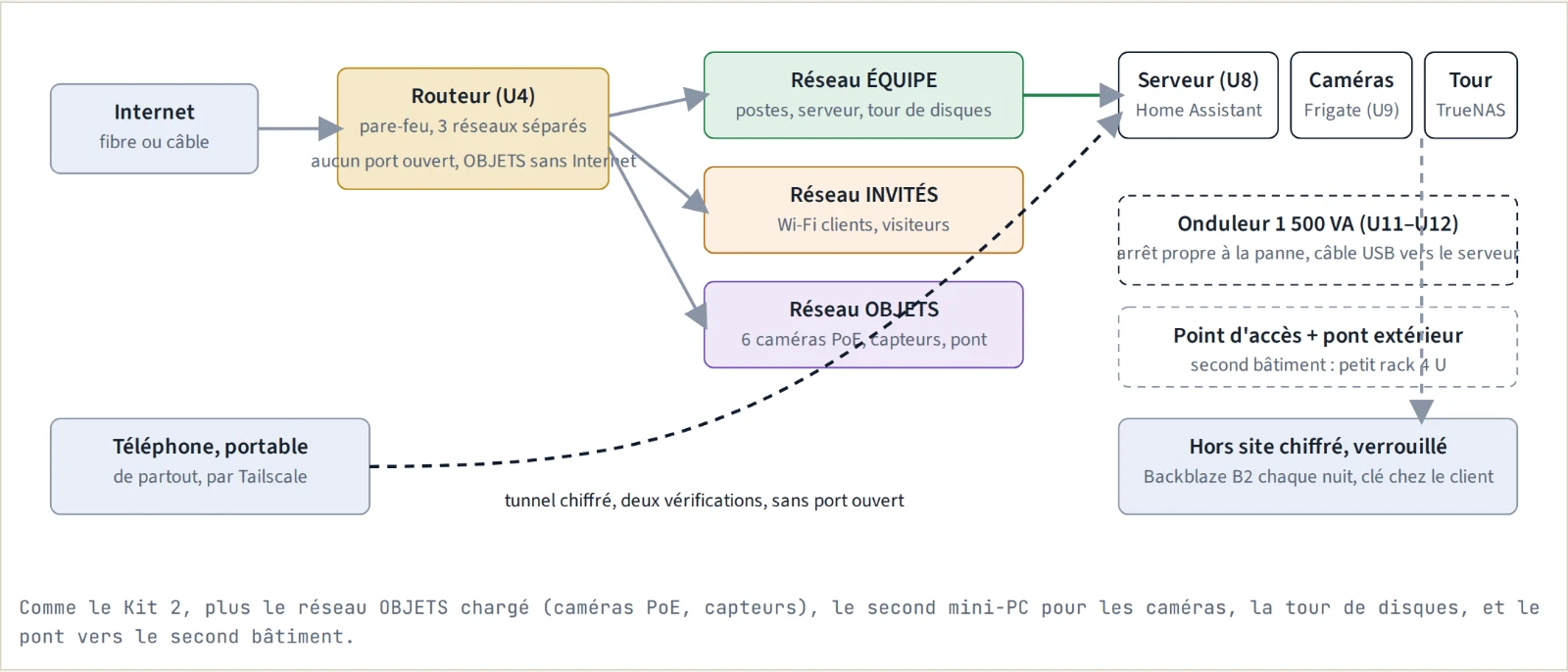
See the network diagram
Network diagram of the Workshop or Farm kit, labelled in French. Internet (fibre or cable) reaches a router (shelf 4) that acts as a firewall, separates three networks and opens no port; the DEVICES network has no Internet access. TEAM network: workstations, server and disk tower. GUESTS network: Wi-Fi for clients and visitors. DEVICES network: six cameras powered through the cable, sensors and the bridge to the other building. Three devices at the top right: the server (Home Assistant, shelf 8), the cameras (shelf 9) and the disk tower. Dashed boxes: a 1,500 VA battery backup (shelves 11 and 12) with a clean shutdown on power failure, and an access point with an outdoor bridge to a second building, which has its own small 4-unit rack. An encrypted, locked off-site backup is sent every night. The phone and laptop reach the server from anywhere through an encrypted tunnel, with two verifications and no open port.
Network diagram of the Workshop or Farm kit: the same base as the Practice kit, with a busier devices network and a bridge to a second building. The labels are in French.
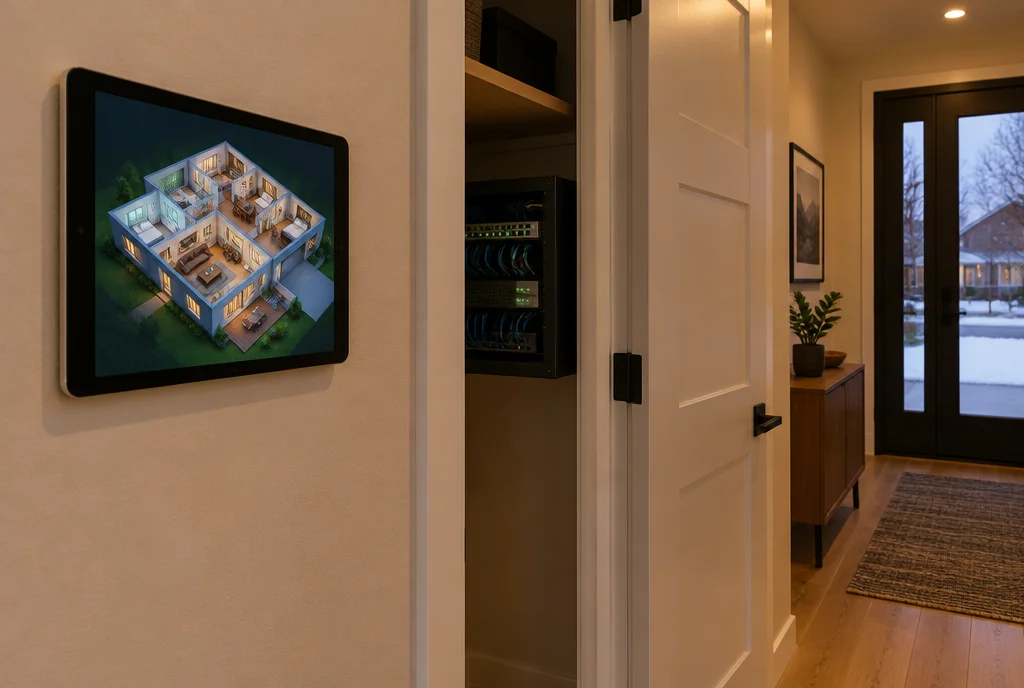
Illustration of a wall-mounted tablet in an entrance hallway: it shows the 3D model of a house in cross-section, with its rooms lit. Next to it, a half-open closet shows a small discreet rack with switches and blue cables.
Computer-generated illustration: the Connected 3D Home kit, a discreet rack and the wall-mounted tablet offered at extra cost.
Kit 4

Connected 3D Home

Discreet 8-unit rack, wired, Wi-Fi included; wall-mounted tablet extra Coming soon

Who it is for
Individual who wants to see their home in 3D and control it with a tap.
Contents
Home Assistant, the 3D model of your home, sensors and devices in each room, a front-panel screen; a wall-mounted tablet can be added, at extra cost.
Promise
See each room in 3D and act with a single gesture, from your phone or, if you add it, from the wall-mounted tablet.

Work: quoted, provided after the free first meeting and the Project launch.

Hardware: quoted, wall-mounted tablet extra.

Coming soon. First clients in early 2027. See the Connected 3D Home page

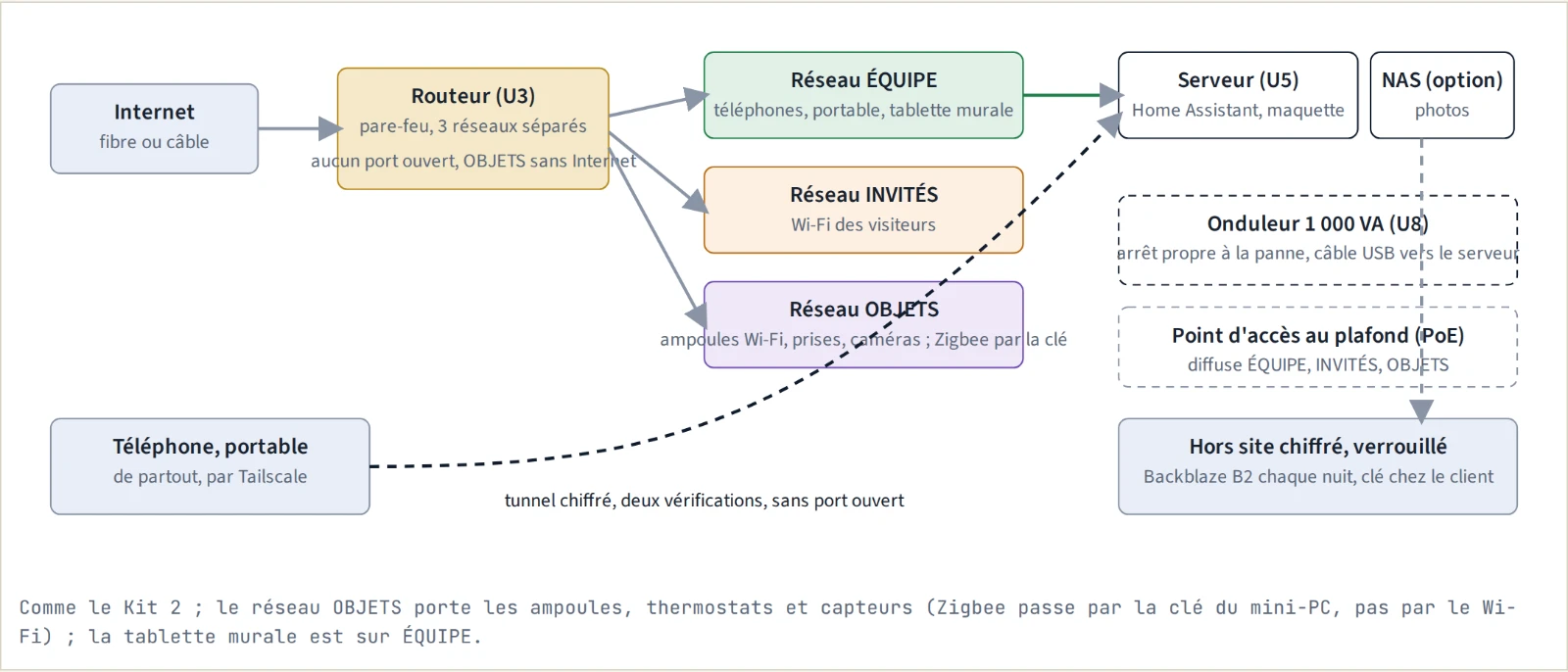
See the network diagram
Network diagram of the Connected 3D Home kit, labelled in French. Internet (fibre or cable) reaches a router (shelf 3) that acts as a firewall, separates three networks and opens no port; the DEVICES network has no Internet access. TEAM network: phones, laptop and wall-mounted tablet; it links the server (Home Assistant and the 3D model, shelf 5) and an optional storage server for albums. GUESTS network: visitors' Wi-Fi. DEVICES network: Wi-Fi bulbs, plugs and cameras; Zigbee devices go through the server's USB dongle. Dashed boxes: a 1,000 VA battery backup (shelf 8) with a clean shutdown on power failure, and a ceiling access point that broadcasts TEAM, GUESTS and DEVICES. An encrypted, locked off-site backup is sent every night. The phone and laptop reach the server from anywhere through an encrypted tunnel, with two verifications and no open port.
Network diagram of the Connected 3D Home kit: the same base as the Practice kit, with the home's devices on the devices network. The labels are in French.

Four points checked with you at delivery

Your files at home

They are stored on your server, at your place, and reachable from your phone, laptop and desktop through an encrypted tunnel, with no port open to the Internet. The only copy that leaves, if you choose it, is the encrypted off-site backup.

A restore done in front of you

At delivery, we delete a file on purpose and bring it back before your eyes. After that, a backup scheduled every night on site and, if you keep them, an encrypted off-site copy every night and an offline drive that you plug in once a month.

Two-step verification to sign in

For access from outside and for every service that supports it: a password and a code from an authenticator app, for each person. Devices that do not support it stay on your local network, with no access from outside; we name them for you at delivery.

One page, one colour

A page sums up the checks we schedule (backups, disks, updates): green, they passed; orange, one of them needs your attention, and the page says which one. It shows on your phone and, depending on the kit, on the front-panel screen or, if you add it, on the wall-mounted tablet. It is neither an alarm system nor monitoring by DRAK Infinity: monitoring is part of the optional Accompagnement (support plan).

These four points describe what we install and what we check with you at delivery. They do not guarantee that no failure or data loss will ever happen: good backups limit the damage, they do not make it impossible. The encrypted off-site backup and the monthly drive are offered to every client; you may decline them in writing. Third-party services remain subject to their own terms.

À la carte: each kit can be adjusted

A kit is a starting point, not a closed box. During the Diagnostic, you choose the options you want; each option is a separate line on the quote. No option price is shown here.

Battery backup

Shuts the equipment down cleanly during a power failure: a USB cable tells the server.

Encrypted off-site backup

An encrypted copy is sent every night to a storage provider, locked against deletion; the key stays with you, and the provider bills you directly.

Monthly offline drive

An encrypted external drive, plugged in once a month for the time the copy takes, then stored elsewhere: a copy that is truly cut off from everything.

Wi-Fi

A ceiling access point, connected by cable, that broadcasts one network for the team and one for guests. Included in kits 2 to 4, optional in kit 1.

Front-panel screen

A small screen in the rack that shows the result of the scheduled checks in a single colour.

Emergency console

A small computer that lets you see the server's screen remotely, even if it will no longer start. DRAK Infinity uses it only with your consent, for a specific intervention. Included in kits 2 to 4, optional in kit 1.

NAS (storage server)

A two-bay storage server, with mirrored disks and role-based shared folders. Suggested for three or more people, or when files, albums and videos take up a lot of room.

Let's talk about your kit

The Discovery meeting is free. The Diagnostic, at $95 CAD, gives you a review of your needs and an annotated shopping list; it is deducted from the installation price if you hire DRAK Infinity for it within 90 days. For the Connected 3D Home kit, the terms on its own page apply.

Free first meeting Home lab Diagnostic ($95 CAD)

Back to the Home lab page